


Reality Check
- Adi Ronen Argov
- Apr 25
- 12 min read

Updated: Apr 25
My political worldview was formed during my youth, at the Friday night dinner table, born out of my need to confront and differentiate myself from my father, who was resolute in his right-wing views.
My activism and my identity as a human rights activist have taken shape over the past six years, through my process of becoming an "elder" – transforming my perspective from the individual to the collective.
And what is that political activism?
The Daily File does not have a date of birth, but rather a process of birth. It evolved from a collection of reports on events in the West Bank in WhatsApp groups of anti-occupation activists, to a structured report at the end of the day, and finally to a website. This has been going on for at least four and a half years: a verbal, numerical, and visual record of the oppressive daily events in the West Bank. Every single day.
Since October 2023, it has expanded to include Gaza, Lebanon, and the 1948 Palestinians; and since June 2025, Iran, or what we call "the additional fronts." This stems from the belief that everything is interconnected, and reporting on only one arena does an injustice to the truth.
The reporting is laconic and repetitive, out of a need to document what happened and to say – it has happened. To refute the sensation of an "exceptional" or "isolated" incident and to present the patterns. A veritable archive.
I began the project Forcibly Involved, which confronts the cynical-militaristic expression "non-involved," in early 2024. it gave a name and a face to the children who were involved against their will – who were never given the option to choose their involvement – and paid the full price, the price of their lives, across the entire region: in Israel, the West Bank, Lebanon, and Gaza (especially Gaza). On a personal level, the wish is the drive to give them an identity, fragments of a life; on a collective level – to create cracks in the wall of collective de-humanization, to say that they were here, and not anymore.
In time, this project became the "Quiet Protest" with the children’s photos, thanks to wonderful female leadership, and even turned into a short documentary. Thus, it moved from the personal to the communal.
Between the project The Daily File and Forcibly Involved, I became a witness-bearer and the storyteller.
But how do you tell the story to an audience that does not want to hear? Is it through shouting, rebuking, and accusing?
But how do you tell the story to an audience that does not want to hear? Is it through shouting, rebuking, and accusing? Is it with such softness that it becomes blurred, avoiding the forbidden words – ethnic cleansing, Nakba, genocide? Who is the audience I am addressing? Does the story being told actually create change? Who even wants to hear a story that shines a fluorescent light on the murderous and oppressive parts within themselves? How can I turn the "Cassandra cry" within me into a motivating story without falling repeatedly into the Cassandra complex?
How can I tell the story to you, here and now, in a way that will have the maximum impact? And what is that "maximum impact"? I have no answer. I have tried everything, furious or reconciled, from contraction to expansion. I prefer to dwell with the question, or to leave it as a question directed to you, the listeners.
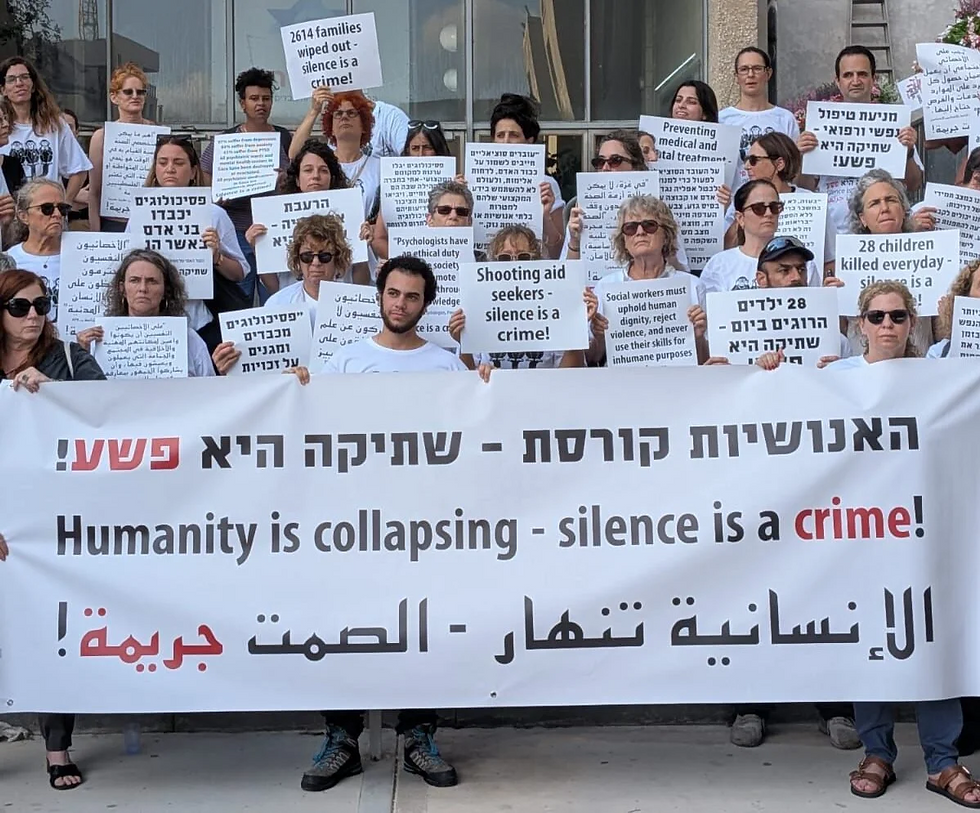
Sometime in August 2025, out of a desperate internal cry and in wonderful synchronization with the cries of others, the "Silence is a Crime" forum was established – a group of mental health and welfare professionals seeking to knock on, or perhaps even kick down, the gates of silence of the professional associations and colleagues. Silence, and even silencing, under the title "Politics-Free". Neutral.
Here too, I encountered the same dilemmas: How do you tell the story to those who are not necessarily interested in hearing it, and who is the audience?
In this meeting, I choose to confront three assumptions that I identify:
1. The first – Settler Terrorism. "Them." "There," beyond the mountains of darkness. While ignoring the "Us" that enables it, the fact that "Them" is an extension of "Us."
2. The second – Let’s talk about the West Bank. Let's not talk about Gaza, Lebanon, or the 1948 territories. A convenient separation, easier for the individual to digest, which strengthens the planner's intention: divide and rule.
3. The third – October 7th is "Day Zero" for the current situation. Well, it isn't.
I want to start with a vignette. October 2021, the town of Beita, south of Nablus. A right turn before entering Huwara toward the Za'tara checkpoint, where residents protest the takeover of their lands on Jabal Sabih by the Evyatar outpost.
Every Friday, they stood before military forces. There were no settlers there (the outpost was then abandoned and stood empty on the mountain peak). People were injured, killed (ten of them), without holding firearms, without any contact between them and the military force. A struggle that, to a large extent, drew inspiration from the struggle of Bil'in.
My Fridays during that period were dedicated to Beita. On that day, the protesters finished their Friday prayers in the playground area. Pictures of the Shahids hung on the fence, alongside a collection of tear gas canisters and rubber bullets in an artistic display of sorts. From there, they set out toward the path on the mountain opposite Jabal Sabih.
The children began practicing with slingshots among the olive trees; the elders began the cries of Takbir. On Jabal Sabih, opposite from them, stood the soldiers, and also further down the path on the mountain where we stood. Two mountains, a valley between them, breathtaking scenery in which a cruel, asymmetrical drama unfolds, a symbol of the oppression of the occupation.
The army began firing – live fire, rubber bullets, tear gas. Through binoculars, one could identify the smiles of the soldiers sitting in the shade. The Palestinians with the slingshots stood in the valley, in a state of strategic inferiority; clearly, their stones did not reach the soldiers.
Before my eyes, the biblical drama of David and Goliath – but who is David and who is Goliath?
And then a cry: "Samira is coming! Run!" "Samira" was the personification given by the residents of Beita to the drone carrying 6-9 tear gas canisters, flown by a soldier and chasing protesters while serving as a "tear gas shower." A means of "dispersing riots," the army would call it. "Dispersing riots" is a euphemism for protest – in the West Bank, it is forbidden to protest or demonstrate. It is a violation of order, punishable by arrest, injury, or death.
I started to run. Previous encounters with tear gas had left me with an unbearable experience, so I ran. In that moment of instinctive reaction, the soldier was my enemy, rage and fear were fueling my steps, the houses of Beita were a place of refuge.
But "Samira" caught up with me and rained down its toxic cargo. Lost, confused, leaking from every orifice, in total disorientation – a cloud of tear gas around me and within me – I lost the distinction between inside and outside, between reality and fantasy.
A masked young man emerged from the toxic cloud and reached out his hand to me. In the state I was in, for a moment I imagined he was a saving angel, and perhaps he was. He began pulling me, half-running, half-carrying me, to the nearest Red Crescent team.
There, still masked, wishing to remain anonymous, he asked the team to translate into English: "I think you are a mother. I love my mother, I respect her. We treat our mothers better than them," he said, pointing toward the soldiers.
And who are "them"? And who are "us"? Every Friday until then and since, the return home from Beita, through the checkpoints, to the Friday dinner, to the detachment, to the blindness, was especially difficult.
This "Beita experience" scrambled everything – who am I, who are they, who are the soldiers (sons of acquaintances?), who is the enemy, who is the lover, and who is David and who is Goliath.
All this without a single settler being there! All this in 2021, two years before October 7th!




‣ Since the beginning of 2026, 40 Palestinians have been killed in the West Bank, 10 of them minors – 8 were killed by settlers, 32 by the army.
‣ Since the beginning of 2026, about 650 Palestinians have been injured, at least 270 of them during settler attacks accompanied by the army. 32% of the injured were hurt due to beatings by soldiers.
‣ Since the beginning of 2026, 1,500 Palestinians from 29 communities have been displaced, 96% of them due to settler violence backed by the army. In the first two and a half months of this year, approximately 95% of all those displaced in the year 2025 were uprooted from their lives.
‣ During one year, 36,000 Palestinians were displaced from their homes due to military operations, the "clearing" of refugee camps (Jenin, Tulkarm, and Nur Shams), settler violence, and home demolitions.
‣ In the month of February alone, 1,965 settler or army attacks on Palestinians in the West Bank were documented.
‣ 9,500 Palestinians are imprisoned in Israel. About half of them are administrative detainees or "unlawful combatants" – without an indictment, without the possibility of a fair legal process. For years.
‣ Palestinians are tried in military courts, where the conviction rate stands at 96%.
‣ In 2024, Israel demolished 1,317 structures in the West Bank due to a lack of building permits (which are practically impossible to obtain), and an additional 452 structures in military operations. As a result, 4,886 people were displaced from their homes, 621 of them as a result of settler violence.
‣ Since 2020, not a single Israeli has been prosecuted for the murder of a Palestinian.
March 2026—a masked female soldier orders a Palestinian shepherd (grazing lands have been reduced to favor the expansion of settler grazing lands) to leave, to abandon the flock and go, now! With her finger raised in a threatening gesture.
"Why?" he asks.
"Because I said so, because it's not yours. Now."
"And what about the flock?" he asks.
"I don't care."
Afterward, the shepherd is attacked and arrested; the flock was likely seized by settlers, unless protective presence activists were on site.
To say "Jewish Terror" and focus it on settlers alone is like saying "The hand struck," without saying "I struck using the hand."
Protective presence activists witness the involvement of security forces in the violent and cruel conduct of the occupation in the West Bank. "The soldiers cannot reach every incident," the Chief of Staff will say. In practice, at best they stand by, and in the most common case, they are an active part. Not once will representatives of these forces lash out at the activists: "If you weren't here, it would be quiet. You are agitators."
I recommend watching the report by the CNN team that was attacked in Tayasir on March 26 by a military force, and the soldiers' doctrine presented there. Despite the shocked reaction of many, these are things that are said often, only this time the victim was an American team, the footage got out, the Emperor is naked. Uncle Sam is not pleased.
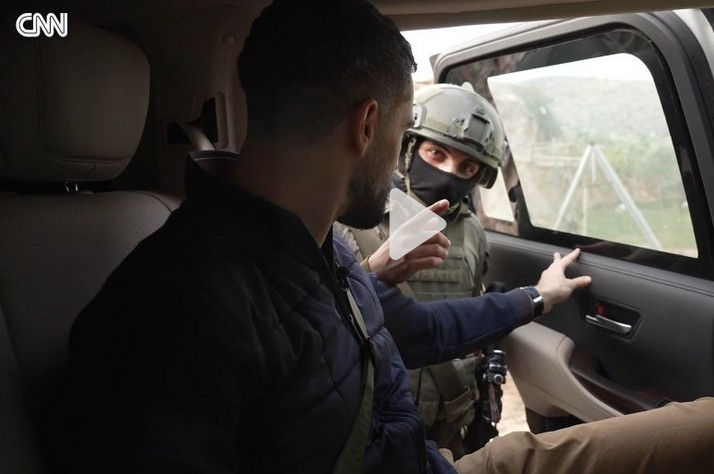
To say "Jewish Terror" and focus it on settlers alone is like saying "The hand struck," without saying "I struck using the hand." It is fashionable, it feels "nice," but in fact, it is gaslighting intended to make us forget that this is a military occupation that ignores international law, under which it must provide for the welfare of the occupied.
To say "Jewish Terror" is an act of splitting – they are the evil, we are the good; they are the aggressor, we are the victim. Splitting enables de-humanization, and this enables cruelty. "Them" – Palestinians or settlers or Ben Gvir. Whatever fits. And what about "Us"?
In practice, for years, and under the "conflict management" policy that characterized Israeli governments until the "Government of Change", at which point conflict management turned into a policy of annexation, the State of Israel has been running an ethnic cleansing project, a continuation of the initial version of the Nakba and the sequel version in Gaza. This project gained momentum in the last two and a half years, under the cover of the October 7th massacre.
Ethnic cleansing essentially means the expulsion of Palestinians from Area C into the central cities, which are encircled by a chain of settlements. Recently, they have also been expelling people from Areas A and B. Ethnic cleansing has several arms – funding, media, language, education, law, army, Shin Bet, police, and settlers.
The act of splitting also exists in the division and separation between the West Bank, Gaza, and the territory of the State of Israel. How is Gaza's destruction different from the Jewish terror in the West Bank? In essence, both are ethnic cleansing, except that the one in Gaza is raw, blunt, and overt, painted in the colors of revenge – a revenge that granted legitimacy to the killing of approximately 72,500 people, of whom at least 22,000 are children; over 58,000 orphans; 2,700 families completely wiped out; starvation, destruction, and the annihilation of any possibility to build and rehabilitate.
The Jenin refugee camp, which has been emptied of its residents since January 2025, is composed of descendants of Nakba refugees from the Haifa area. The Abu Daqqa family, which lost hundreds of its sons and daughters in Gaza, is the same Abu Daqqa family from Jaffa.
And perhaps the separation between Gaza, the West Bank, and Israel allows for an organization, a hierarchy – the goal of which is convenience – some kind of mental well-being and a separation between the justified and the unjustified for most of us. Or at the end of the day, "divide and rule" for those leading the way.
M., a Palestinian activist and resident of the north, expressed much criticism of Israel's policy. About a month ago, he was arrested on charges of incitement, stripped of his clothes, his head was placed inside a barrel, and his hair was shaved while the police verbally humiliated him and physically beat him. He was released after a few days without conditions other than a two-week silencing on social media. The court criticized the lack of justification for the arrest.
A five-year-old child, a resident of the West Bank suffering from leukemia, cannot be evacuated for life-saving treatment because he was born in Gaza. A five-year-old child is sentenced to death by an Israeli judge because he was born in Gaza.
Israel's policy was not born on October 7th, nor with the rise of the right-wing government to power. It is the result of years in which the conflict was "managed." That is, Israel avoided dealing with the Palestinian issue. The intensification of the cruelty of oppression began sharply in 2021, during the days of the "Government of Change," when Bennett began what was called the annexation policy. Further intensification began when the right-wing government removed any mask of alleged humanity, and it openly declares its intention to cleanse, to destroy, to kill.
I wish to end with stories: The first, about the testament of 16-year-old Ghayth; and the second, the story of the cruel death of 14-year-old Jadallah. Both existed and are now gone.
‣ Ghayth Rafiq Yamin, 16 years old, a resident of the Balata refugee camp in eastern Nablus. On May 25, 2022, settlers secured by the army went up to Joseph's Tomb located in the camp. Clashes broke out. Ghayth was shot in the head (shooting to kill) and 75 other Palestinians were injured that night. At Joseph's Tomb, they celebrated.
After his death, his testament was discovered: "Do not put me in the freezer, because I do not like the cold. When you decide where to bury me, do so in a place where there are children so that I will not be lonely. Keep my social media accounts open, and from time to time post something on them so that I am not forgotten. My favorite bracelet is under the pillow. Do not lose it. Recite Quran verses for the ascent of my soul, with my name appearing on the first page. Come visit me every few days. Talk to me. I will listen. Do not cry, I do not like to make anyone sad. I do not want anyone to cry because of me."
‣ Jadallah Jihad Juma'a Jadallah – Jad to his friends and family – 14 years old, a resident of the Al Far'a refugee camp, was shot to death on November 16, 2025. He existed and is now gone. Videos document how for 45 minutes he lay dying, while asking for help as a group of soldiers surrounded him, indifferent, filming, looking at their phones. He threw his hat, they threw it back at him. He raised a hand, then two, they ignored him. Neighbors and relatives watched what was happening; the soldiers fired at the mother who tried to reach her son. Eventually, he died, and his body was taken to the freezers that Ghayth so feared. Jad is one of 55 children killed in 2025, one of 77 minors the army is holding in the freezer to prevent their burial.
They were here, and not anymore.
And here my Cassandra has come out. A little hope – I do not believe in measuring the impact of my actions. The impact is minimal. The process of recognition, taking responsibility, and transitional justice will take generations. But in the very act of doing, I demand of myself every day to look at all the parts of me, to stretch the very limit of my comfort. And perhaps, even in the outskirts of my soul, to prove to myself that I am better than them. That I protested while others remained silent. It is possible.
But for there to be change, we must begin with the persistent work of expanding the boundaries of consciousness...
Remarks by Adi Ronen-Argov at the "Silence is a Crime" webinar.


