The Performance must End
- Hamze Awawde

- Feb 27
- 5 min read
Do you know that feeling when you look at the world and somehow one plus one just doesn’t add up to two? When the mouths of the people in front of you are moving, but no sound seems to come out? When everyone is rushing around in every direction, yet to you it all feels like it’s happening in slow motion? It’s as if your eyes see and your ears hear, but your mind refuses to believe.
For me, this has become a daily experience in recent years, ever since this nightmarish government came to power. And it seems to me that this is precisely what Hamze Awawdeh is writing about—only from a sober, clear-eyed perspective rather than from emotion, and from a view of the Palestinian reality rather than the Israeli one. Because in the end, here as there, the same question lingers: how is it that so many people, so many forces, so much money are working to make things better—and yet they keep getting worse?
For the sake of full disclosure, I should say that Hamze and I worked together for three years, and I am proud to call him a friend.
Ayala Shalev, Editor, That’s About Us
The Performance must End
Hamze Awawde
Those of us who have not lost touch with reality and everyday Palestinians in the land have learned something in recent years that few are willing to say aloud because it sounds like surrender. It is not surrender. It is the condition for anything honest to begin.
When I say “we” here, I mean Palestinians who hold positions, platforms, resources, or influence: officials, party cadres, NGO directors, business leaders, intellectuals, and those in the diaspora who speak in our name. When I say “our people,” I mean the wider society that lives the consequences of these choices.
There is now a wide gap between the rituals of Palestinian political life and the lived reality of our people. We attend the meetings, draft the strategies, and issue the statements. We build conferences around words like liberation and sovereignty. Yet the material life of Palestinians continues to deteriorate.
By “performance” I mean something specific and ordinary: the political activities that make us appear active while the conditions beneath them, how people eat, learn, heal, work, and stay on their land, worsen. It is everything we do that looks like politics but does not alter the substance of daily survival.
You could see this most clearly in Gaza. As the bombardment pushed families into tent cities, ordinary citizens documented the war on their phones and in their own words. They reported from the mud, the queues, the makeshift classrooms, often with more clarity and courage than any official channel. They did this in almost complete silence from Palestinian national media, and without a single direct message from a political class that was busy negotiating its place in the post war order behind closed doors. Our people were broadcasting their reality to the world. The institutions that claim to represent them rarely spoke back to them.
Naming this is not an invitation to give up. Continuing to perform importance on a permanent crisis stage, while avoiding the harder work of transformation, is its own kind of abandonment.
For years, many of us believed that if we spoke the truth about justice clearly enough, the world would act. We were not wrong about justice, but we may have been wrong about language. Words alone did not alter power. The language of liberation slowly gave way to a language of management, while control expanded through zoning, infrastructure, military orders, and law. Annexation arrived by accumulation, not declaration, and many of our parties and NGOs learned how to survive inside that grammar.
Steadfastness, or sumud, was meant to be resistance. Families stayed on their land, raised children under siege, and rebuilt after demolitions. It was dignified and necessary. But endurance without a plan becomes a slower form of losing. It reassured foreign governments that our tragedy was manageable, allowed Israeli leaders to escalate without paying a decisive price, and became, for Palestinian elites, a story of patience used to excuse the absence of results.
Meanwhile, the formal political system adapted to disaster instead of stopping it. Emergency meetings, donor pledges, and high level visits turned crisis into currency for institutions, even as real governance withered. Legislative bodies stopped working, and public institutions lost people’s trust.
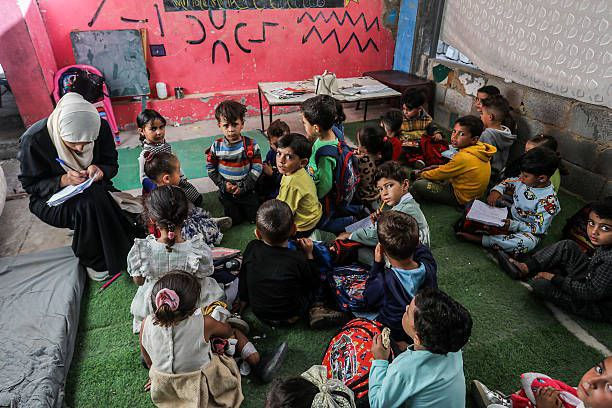
Yet beneath these formal structures, another Palestine persisted. Teachers held classes in shelters. Volunteers provided healthcare. Women’s cooperatives kept neighborhoods stable. The same citizens who documented the war from Gaza’s tents also organized food, schooling, and basic order when formal structures disappeared. Our society did not lose competence; our institutions failed to organize it into lasting power.
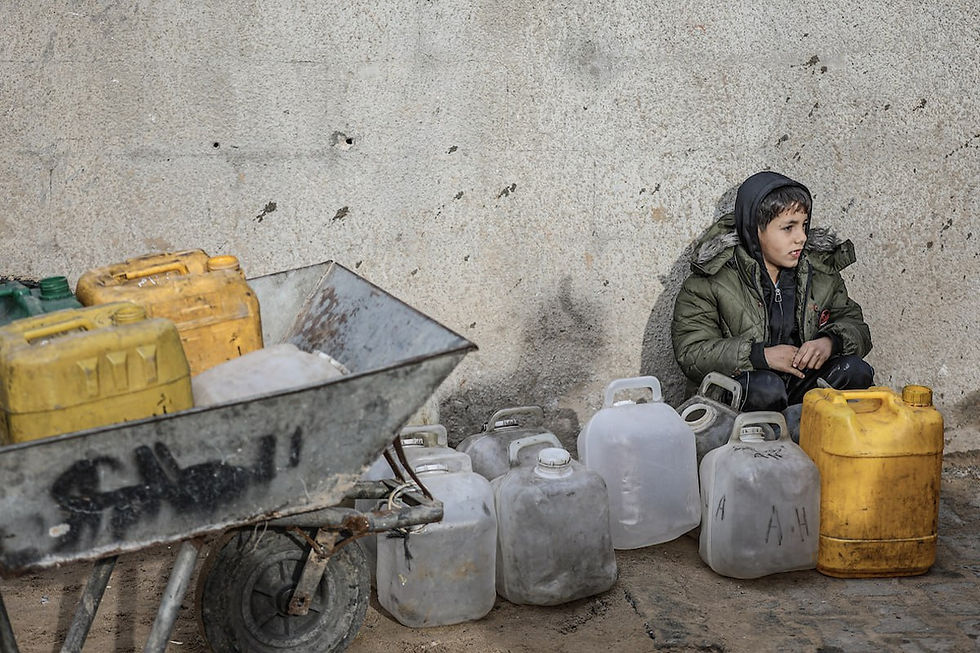
If performance is the problem, the alternative is functional sovereignty: not something bestowed through external recognition, but something built in practice through lived systems. Sovereignty begins in education that continues under bombardment, in water that reaches people under restriction, and in clinics that function when hospitals are destroyed.
For those of us with resources, this requires a reorientation of what we control. Professional classes must stop treating survival as an abstract project. Universities should partner directly with community schools to guarantee educational continuity. Bar associations must coordinate sustained land defense campaigns rather than reacting to case by case fires. Business chambers must prioritize local production and worker protections over dependency.
This shift also requires a “citizens diplomacy” protocol for global partners. International allies and donors should listen first, fund what communities request, and bypass factional gatekeeping: local legal aid funds and land defense work, secure teacher exchanges and distance learning support, and community health and psychosocial programs designed with consent and protection. Solidarity should be measured less by statements and more by whether it strengthens the people who keep schools open and families rooted.
Underneath all of this is a simple accountability question everyone claiming to represent Palestinians must answer: What will life materially look like in ten years if your strategy continues?
We do not have to wait ten years for an answer. With municipal elections planned for April 2026, this is the moment to demand accountability. Any candidate seeking legitimacy should commit, in public and in writing, to transparent budget reporting, basic service delivery metrics for water and health, and clear plans for building local capacity under constraint, with timelines that residents can actually track.
If leaders cannot answer these questions, the rest is performance. And if those of us who sit on boards or control platforms continue to offer them access without demanding clarity, we are maintaining the performance.
The geography is fragmented. Gaza’s people are still in tents. The West Bank is divided by military zones. Palestinian citizens of Israel face narrowing civic space. Refugees are scattered. This is the terrain on which our politics operates.
We can decide whether we keep reacting to others, or whether we build weight from below, in the schools, clinics, cooperatives, courts, and councils answerable to our people, insisting on justice even under injustice.
The tragedy is not only that institutions have weakened. The deeper tragedy would be choosing to preserve their illusions at the cost of our people’s future. The performance must end. Not because we are giving up, but because endurance without transformation is only survival. And when the challenges intensify, even survival cannot be taken for granted.
Hamze Awawde is a Palestinian activist, conflict resolution expert, and speaker.