Where Is the Palestinian Gandhi?
- Yariv Mohar

- Jan 2
- 5 min read
Updated: Jan 4
I often hear people asking, “Why aren’t there Palestinian peace leaders?”Never mind that, once again, we look at “them” as if we have leaders who spend all day sincerely trying to make peace; or that there is no real symmetry in the balance of power; or that Israel has a long record of sidelining, imprisoning, or eliminating Palestinian leaders and activists who try to struggle through nonviolent means.
When I hear these arguments and try to respond to them, I realize that it is almost impossible to have this conversation at all when, deep within my interlocutor’s basic assumptions, there is an ingrained dehumanization of Palestinians as such. Yariv Mohar writes about this in depth here.
Ayala Shalev, Editor, That’s About Us
Why Is It So Hard for Us to Accept the Existence of Palestinian Leaders like Gandhi?
Yariv Mohar
Recently, several people I respect, despite some disagreements, managed to infuriate me. I had to remind myself that anger may be a good starting point for on-the-ground activism, but it is not a great foundation for productive dialogue. In response to the Pro-Human Campaign’s project documenting Palestinian “Gandhis”, leaders of nonviolent protest among the people we rule, a series of posts titled “Where Is the Palestinian Gandhi? Come Discover What Became of Him”, they raised a series of dismissive arguments:
“With Indian Gandhi, nonviolence was a principled commitment; among leaders of Palestinian nonviolent struggle, it is instrumental.” And further: “If the moment they see that nonviolent struggle does not work they turn to violence, then they do not truly believe in nonviolence.”
Another argument went like this: “They use legitimate methods, nonviolent struggle, to advance illegitimate goals, from our perspective, namely the right of return, which is understood as a move toward the destruction of Israel, at least as a Jewish state.”
“At the bottom line, he does not recognize our right to national existence,” someone wrote about Mubarak Awad, perhaps the most iconic of the Palestinian nonviolent leaders of the 1980s.
“The Palestinian discourse prefers to tell stories about its own nonviolence rather than doing the work required to create a nonviolent struggle,” another wrote, referring to the movement as a whole.
These are people I genuinely respect, and not right-wing figures, but rather center-left. And so I was left wondering how they fail to see the impossibly high standard Palestinians are required to meet in order to be considered nonviolent: suspected even after having proven their “innocence” through signs and wonders. All this without even touching the question of whether violent resistance against security forces, as opposed to civilians, would be considered legitimate in other contexts of oppression around the world, a far more explosive issue, laden with emotion, especially given that many of us have loved ones who have served or are serving in the IDF or other security services.
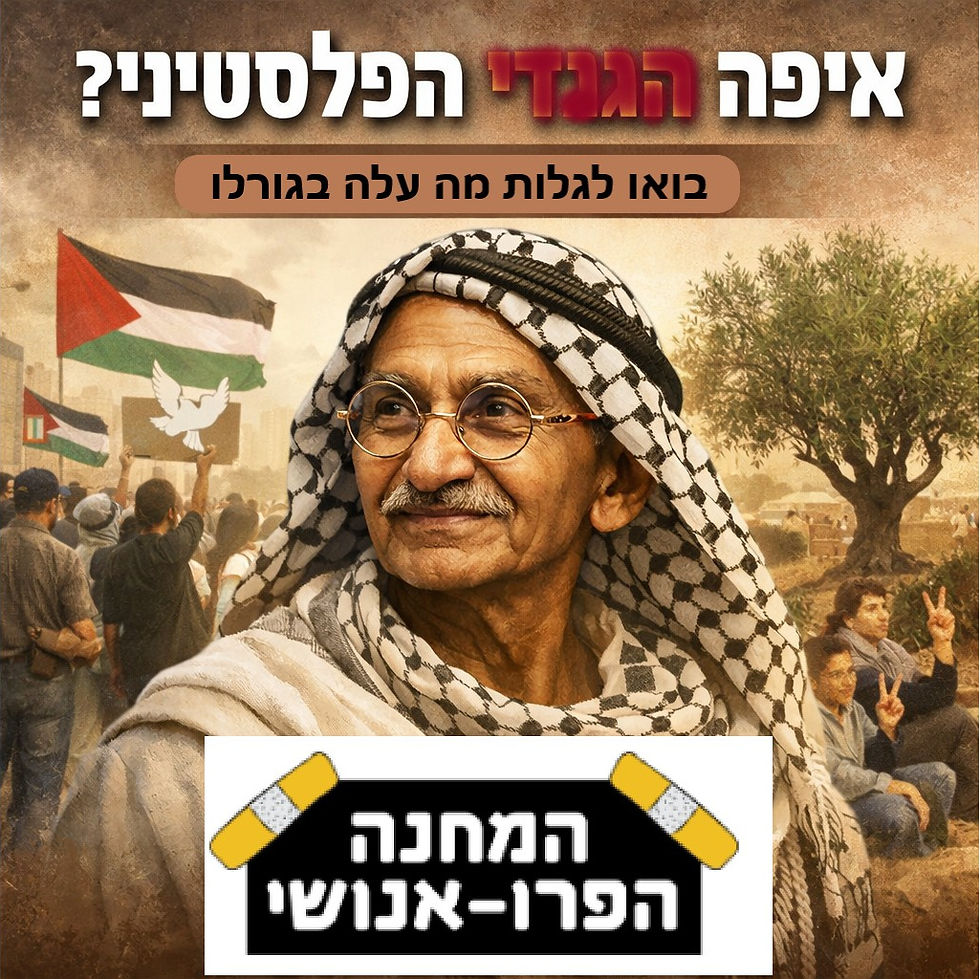
So let us examine the arguments more closely.
Is Palestinian nonviolent struggle instrumental? If so, instrumental to what? Sadly, Palestinian nonviolent struggle has failed more often than it has succeeded. Violent struggle, by contrast, has brought Palestinians a number of achievements. Horrifying as it is, even the October 7 massacre did succeed in bringing the Palestinian issue back to the forefront of global attention, albeit at an atrocious cost. More concretely, the leaders of nonviolent struggle we documented paid terrible personal prices for their activism, with little to show for it. Those who were not shot dead endured injury, imprisonment, or exile from their homeland. And yet, they persisted for years, sometimes decades, in nonviolent struggle. They did not turn to violence. Some of them did so without any fame or public recognition, simply as rank-and-file participants.
What more is required to demonstrate a principled commitment to nonviolence? Is it possible that our deeply ingrained image of Palestinians as inherently violent blinds us to the ability to recognize principled nonviolence when it is right in front of us?
Now to the claim that Palestinian discourse prefers storytelling over real work on the ground. How can such a claim even be made? Palestinian nonviolent struggle is, above all, a grassroots struggle. Unfortunately, it receives only limited recognition within Palestinian public discourse. This is not a movement driven primarily by branding or marketing. Even the documentation, the presence of cameras, is less about telling a story about oneself and more a desperate attempt to restrain violence by security forces and settlers, and to hold perpetrators accountable for violence against the movement.
Next, the question of ends versus means, or the demonization of the right of return. One does not have to agree with the right of return. ( I personally believe that large-scale mixing of populations that have accumulated a century of resentment could lead to a dangerous explosion for both peoples, especially for the weaker side.) Still, the assumption that someone who supports the right of return for people expelled from their homeland, a right recognized in international law in principle even if rarely in practice, does so as part of a malicious plot to destroy Israel is absurd.
One can argue that such a move would, in practice, lead to Israel’s destruction, and that too is debatable. But there is a fundamental difference between malicious intent and support for a policy that some believe would result in disaster. By the same logic, many on the right claim that the 1967 borders are “Auschwitz borders,” implying that left-wing supporters of a two-state solution are effectively advocating the destruction of Israel. And just like that, half the population, at certain moments, turns from political adversary into an enemy unworthy of being heard.
Politics is full of disputes in which both sides believe the other’s policies will lead to catastrophe. Yet as long as those positions are advanced through nonviolent means, they are considered legitimate, unless, apparently, the people advancing them are Palestinians. It is worth recalling that South Africa’s apartheid regime framed the abolition of apartheid as a step toward the destruction of white communities in southern Africa.
In short, one does not need to agree with nonviolent leaders such as Mubarak Awad on every issue in order to acknowledge and appreciate their extraordinary ability to endure severe oppression while remaining committed to nonviolence.
So yes, there are Palestinians who are deeply committed to nonviolence. Beyond this hard core, in the wider circles of struggle, there are also those for whom nonviolence is looser or more instrumental. And the more nonviolent struggle is repressed, the more people shift toward other approaches, some toward despair, others toward violence. In this way, we not only commit an injustice, but also shoot ourselves in the foot by encouraging the violent path.
The fact that even center-left Israelis fail to see this illustrates the depth of the tragedy and the power of anti-Palestinian propaganda to obscure reality. Re-humanizing Palestinians does not mean they become Zionists, nor that we must agree with them on everything. One can disagree with them sharply without viewing them as malevolent actors bent on Israel’s destruction, especially when they have demonstrated such a profound commitment to nonviolence. This is the humanity we need to restore to our way of seeing.
Yariv Mohar is the director of the Pro-Human Campaign, a global coalition of organizations and groups working against the dehumanization of Palestinians, Israelis, Muslims, and Jews.